Friday, May 3, 2013

Olympics Field Trip

Saturday April 27, 2013
Cloudy, Rainy, Chilly

After a long car ride we finally reached NatureBridge, I was excited to eat my lunch but even more excited to explore around the trails and see what was in store for us for the rest of the day! We started out as a class on The Moment in Time's Trail and we were able to ID and see some really cool wildflowers like Fairly slipper orchards which were purple/ pink in color and were quite small. I noticed how much thicker and taller the trees in this forest were compared to trees in Ravenna Park or Union Bay Natural Area as well as Lincoln Park. The Douglas firs, Western Hemlocks, and Western Red Cedar, as well as Grand firs had a lot of moss around there branches, actually there was a lot of moss everywhere! The moss explains how the Olympics receive a lot more moisture and rain than forests/ parks around Seattle. The stair step moss was very abundant in the area. We came to an area where there was a lot of wester red cedars, a long with a lot of sword ferns, which was a good indicator that there was good nitrogen rich soil. We also stumbled upon some vanilla leaf, when dried smells like vanilla! I would have never known, it was three leaf compound. While we were in the area I learned that the forest especially one like this, an old growth forest is very complex. A lot of organisms have symbiotic relationships like old snags and logs provides structure for other trees to grow on like western hemlock. They provide an elevated structure off the forest floor so there is less competition for trees using theses snags or logs (nurse logs). We walked a couple ways through the moment in time's trail and found some trillium! The flowers of this plant were white and so pretty. I never seen Devil's club, so I became excited and a little bit frightened when I saw this tall stalk plant with armored thorns covering its every surface area. Next we split up into groups and depending on your interest in where you want to hike to, Storm king, Marymere falls, or Barnes creek is where you and a group of others go on to explore. I joined a group to hike up Storm king. This hike was a tough one, it was an inclined hike and there was a lot of interesting plants as we hiked! A dramatic change I noticed as we got higher in elevation was that there was more abundant Salal around, which means the soil was nitrogen poor. We also stumbled upon what seems to be a pea vetch, and a pincherry? There was also a lot of red huckleberry, and we were able to spot a evergreen huckleberry, which had darker colored leaves. Continuing up the hike we found TWIN FLOWER! Which was cool because Tim gave us some background about it being Linnaeus's favorite flower. There was also Madrones, ocean spray, baldhipped rose, and monkey flowers .  We also spotted some native pigeons in a clearing, and on the way down a raven!

Fairy slipper orchids! (not the best picture)

Trillium! 

The view of Lake Crescent when we reached close to the top of Storm King

Devil's Club

Red huckleberry

Monkey Flower

A panorama shot of Lake Crescent at 7 am on Sunday April 28

The tallest grand fir

A pea vetch we found when while we were on our way up Storm King

A shot of Marymere falls!

Sunday April 28, 2013
Sun breaks, cloudy, chilly

We left Nature-bridge around 930am and were on our way to Salt Creek and Tongue point! Here we found a lot of interesting organisms and loved every moment of it.

An example of disturbance, where patterns or patches on the mussel beds have experienced tidal storm waves

A picture of a limpet

Pacific Blood Star

A small crab, I wasn't able to ID 

An example of scarring from predation 

A hermit crab eating a snail! Predation

Two Chitons!

A nudibranch

Goose barnacles! an example of facilitation? 

Huge anemones !

A panorama shot of tongue point

Ochre sea stars!

Competition: A lot of anemones crowded together 


Monday, April 22, 2013

Week 3

Date: April 21, 2013
Time: 10:30 - 11:30 am
Weather: Cloudy, light drizzle
Temperature: about 50 degrees Fahrenheit

It was a cloudy sunday morning, with a light drizzle as I walked to my location. It was warmer than last  weeks visit. I heard birds chirping above me, hoping I would see one around my location this sunday. I noticed that the plants that I was unable to ID my first week, was Indian Plum.  They were growing taller from the first time I saw them. I also noticed Red Huckleberry in my location too! At first I wasn't sure if it was huckleberry, but I remembered that the leaves of the huckleberry are "zig-zaggy" or just everywhere and they were tiny and elliptical. They were also a brightish green color. At my location there was a lot of Salal around, I identified them by the texture of their leaves, a leathery tough kind of texture. I was surprised to see a beaked Hazelnut  nearby, but as I was looking through my site there was more than one beaked hazelnut, there was 2 or 3. I was excited/ surprised that I didn't see them before! They had very soft leaves like thimbleberry, the bark was brown and smooth. I did not see any flowers or catkins blooming yet. I went to check on the oregon grape from last week and I noticed more flowers blooming as well as that the oregon grape was a tall oregon grape because underneath the leaf, the vien was rigid and not smooth compared to a dull or short oregon grape. Then I checked on the thimbleberry nearby, it had more leaves and grew a little taller, but no flowers yet. The red elderberry still has the same flowers from last week, but yet no berries. But when I came around to check on the salmonberry, I saw berries that were forming! I have never seen berries that are not yet fully bloomed or I have never seen a process like this occurring. I was really excited after seeing the salmonberry. There was a plant I saw that had a lot of thorns, maybe a Nootka Rose but im not sure. While I was walking towards the beach area of Lincoln Park I was able to spot a hummingbird! It was perched on a tree branch high above me.

A picture of my area within Lincoln Park 

(picture of red huckleberry leaves) Red Huckleberry: 
Latin Name: Vaccinium parvifolium
Part of the Heath family 
The leaves small and elliptical in shape. The berries are a bright red in color and their bark is a bright green. Their flowers are small and jug-shaped with a pinkish color. 
(The huckleberry in the above picture does not have it's flowers or leaves yet)

(not the same Indian Plum from week 1)
Indian Plum
Latin Name: Oemleria cerasiformis
Part of the Rose family 
The leaves are also elliptical in shape, but a lot bigger in size then the Red Huckleberry's leaves. The bark is a brown-purple color. If you take one of the leaves and crush it/fold it, the leaf will give off a scent. The scent smells similar to a cucumber.

Tall Oregon Grape (repeat picture from Week 2)
Latin Name: Berberis aquifolium
Part of the Barberry family
Has even pinnate compound with 5 - 9 leaflets. The leaflets are elliptical in shape and are serrated or spiny (like holly). The flowers of have a yellowish- green color and are grown in clusters. If you turn one of the leaflets over, you can feel that the spine is very rigid and rough in texture. 


Beaked Hazelnut
Latin Name: Corylus cornuta
Part of the Birch family
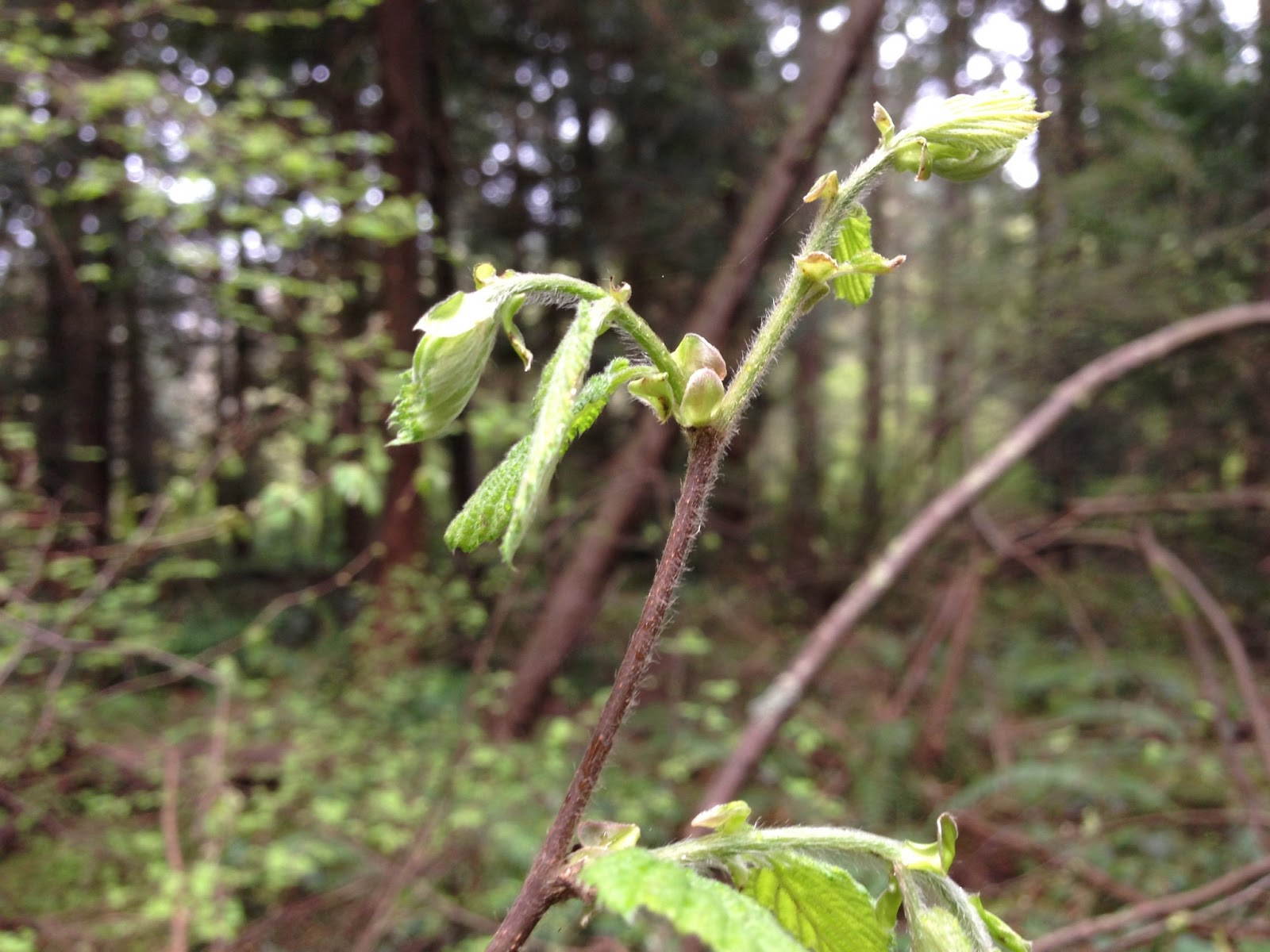
The leaves of the plant are ovate in shape and are very soft like thimbleberry. They are also serrated or toothed. The bark is brown and smooth. The flowers that grow are called catkins which have a yellowish color to them. 

Thimbleberry 
Latin Name: Rubus parviflorus
Part of the Rose family 
The leaves are 5 lobed and have fine hairs on top of the leaf and bottom. They are very soft when you touch them. The stems are a green to brown color. Flowers are white in color and have a papery petals. When the berries bloom they will have a red/crimson color. 

Salmonberry 
Latin Name: Rubus spectabilis
Part of the Rose Family
Have compound leaves with 3-5 leaflets. Leaflets are ovate in shape and are toothed/ serrated? The stems are a lightish brown color and have thorns. The flowers have a reddish - pink color, fuchsia. They have 5 petals and look papery- crinkly. When the berries bloom they have a crimson to yellow color. 

Salal 
Latin Name: Gaultheria shallon 
Part of the Heath family 
The leaves are ovate in shape and are toothed. They are evergreen and the leaves have a leathery texture to them. The flowers are small and white to pink in color, they are bell shaped and grow in long clusters. When the berries bloom, they area purplish/black in color. 

Red Elderberry
Latin Name: Sambucus racemosa
Part of the Honeysuckle family
Has opposite, pinnately compound with 5 to 7 leaflets. The leaflets are Lanceolate in shape and are toothed. Has week stems and the flowers grow in conical clusters, they're white in color. When the berries bloom they are red in color and very small. 
A photo of the thorns I saw on a plant/ shrub. Possibly a Nootka Rose? 

Monday, April 15, 2013

Week 2

Date: 04/14/13
Time of Day: 10:23- 11:30 am 
Weather: Cloudy but mostly sunny
Temperature: about 45 degrees Fahrenheit

It was a gorgeous sunday morning as the sun was shining through light clouds in the sky, birds chirping and a couple of crows cawing here and there. The temperature was a little chilly but warming up surely into the afternoon. When I had reached my location, I was excited to see what has changed or not changed. Of course the same western red cedars and douglas firs were standing tall. I noticed more ferns blooming and was able to identify the Lady fern nearby the western red cedar. I was able to identify it by how the the leaves start from small to big and then small again. I also noticed a thimbleberry, that I had missed last week, the leaves had 5 lobes and attained tiny hairs on both sides of the leaf and was serrated. I found a couple smaller plants in the ground cover, I  sketched it as well and later ID the plant to maybe a Tall Oregon grape or Cascade Oregon grape. It was small and the flowers were budding in the center of the plant near the ground, which had a greenish/yellow color to them. Where the leaves of the plant grew around and they were long and serrated and pointy (like holly?), and grew symmetric of each other. There was another shrub that looked similar but was bigger. I think it was a Pacific Red Elderberry. The stems were really weak, I accidentally pulled to hard on one of the stems to get a closer look but it broke, I felt horrible. The leaves on this shrub was very elongated and serrated, they were "light", and grew opposite of each other. I also noticed the flowers that bloomed in the center, they were white/ivory in color, and grew in conical clusters. I was excited to see the salmonberry from last week. It had bloomed more flowers! But still no berries. 

I did the 4 sketches based on memory sketching:
Possibly an Oregon Grape. I sketched the leaves first and then drew the flower buds after.

Thimbleberry!

Pacific Red Elderberry

Small, just blooming fern

 I did exercises 1-8 (labeled 3-8) with Salmon Berry!


I wanted to show some color with the study drawing


A shot of the Oregon grape

I was able to get a quick picture of the fly-like species that landed on one of the Pacific Red Elderberry leaves.

Another shot of some salmon berry (I chose this one to sketch). 

I wish I took a picture of the small fern, I have one from last week (picture not posted) but not this week. I took advantage of the sunshine and mostly sketched, rather than taking pictures. Hopefully in future posts I will provide repeat pictures of my area and of species to better see the progress along the quarter. 


Monday, April 8, 2013

Week 1

Date: April 07, 2013
Time of Day: 12pm- 1pm
Weather: Cloudy, Rainy
Temperature: 45 degrees Fahrenheit

My observation site for this quarter is Lincoln Park, located in West Seattle, near my parents home. This park is amazing! I grew up going to this park on weekends with my family and friends. I enjoy the wooded areas of the park as well as the beach area, where it is surrounded by the Puget Sound.

Although today was a rainy and a tad bit chilly, there was a lot of life in the park, it sounded and looked like spring was in the air. As I was walking through the park to find the exact location I wanted to observe throughout the quarter, I heard a lot of birds chirping in the trees above me. I was not lucky enough to see any today but hopefully in the future I will be able to. As I kept walking throughout the park I decided to venture out and leave the trail, as I find my observation sight. I have never really looked closely to all the different kinds of trees and species that were in Lincoln Park, even though I love walking through the wooded areas and the beach side. I hope throughout the quarter, I will be able to see more and more species as well as become a better observer to the natural world around me.

In my area I was able to find about 6 trees. They were curved upwards from their roots, had strips of bark that were a cinnamon red color. These trees were Western Red Cedars, which were about 1-2m in diameter. When I looked around my feet there was a lot of understory, or ground cover. Most that are starting to bloom. There was a lot going on so it was hard to choose what species to look at. I found a couple ferns that were already bloomed or are starting to (I was not able to ID but possibly in the future I'll be able to). I saw a lot of moss cover on trees that have fallen, as well as branches. I found a little plant starting to bloom but was not able to ID it as well, but on the plant I found a small spider that caught my eye.  I walked more into the wooded forest and stumbled upon a Douglas Fir, which sat next to another western red cedar and in the distance a Western Hemlock. The douglas fir was high, and I was unable to see how high without having rain drops blur my vision. The western hemlock was growing on top of a stump from an old tree, it was pretty small in diameter. I also found a Big Leaf maple tree in my area. On the ground cover I found some holly that was starting to bloom as well as some blackberry, which I was not sure that they were native to our environment. There was also an interesting bright green fern that attracted me, so I took a closer look and it was a common sword fern, I think. It looked fully bloomed and was growing or grown with a tree closely behind it. I walked a little ways near my area and saw a flowering plant, it was starting to bloom, with green leaves and pink flowers, the branches or stalk had thorns so I thought maybe its a type of berry vs. a flowering plant. I was able to ID it as Salmon Berry.  I wish I could've ID more species or be able to see some birds and insects, maybe I'll move around a bit more to see what else I can find next week. Although it was a rainy day, the wooded areas of Lincoln park was alive, with the birds chirping in the trees and the plants growing all around. I can't wait to see how much will change over the course of this quarter at my location.

two of the western red cedars in my area

a plant that I wish to ID soon, there were a couple of these blooming

small spider that I happen to see climbing up a small branch

the base of the western hemlock, growing on top of an old tree stump

Found a douglas fir and a western red cedar happily accompany each other

I think this is the common sword fern that I was explaining or possibly a deer fern? 

The salmon berry, which attracted my attention with its pink flower.

Again, the salmon berry. Only one was bloomed so I got a little too excited when taking the picture (unfocused).